Should You Sell Your Grand Rapids Home Before Buying Up?
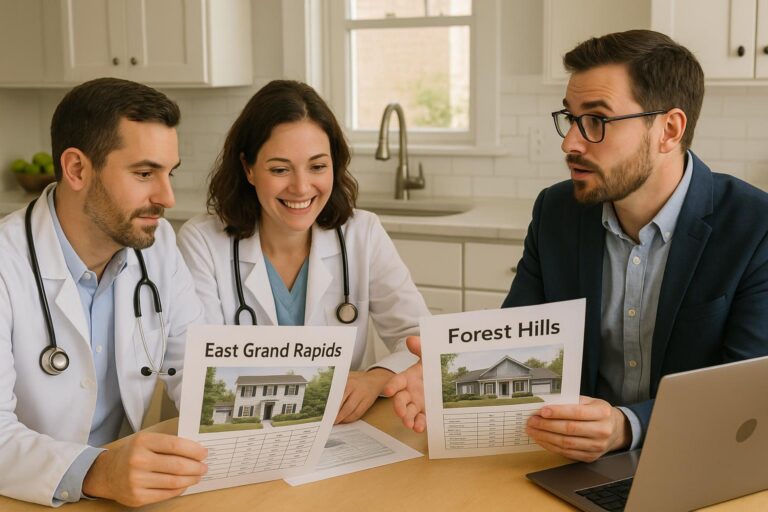
If you’re a dual-income physician or medical professional household in Grand Rapids considering a move to a higher-priced home, the decision to sell your current property before buying the next one is crucial. Selling first can ease financing and reduce risk, but it also impacts your move timing, temporary housing needs, and ability to compete for your ideal home—especially in popular neighborhoods like East Grand Rapids, Forest Hills, Ada, Cascade, or near Medical Mile.
Quick Answer
Most Grand Rapids medical households sell their current home before buying a higher-priced property if they need their existing equity for the next purchase or want to avoid carrying two mortgages. However, if you can qualify for both mortgages and want to secure your ideal next home before selling, buying first is sometimes possible—though it comes with more risk and requires careful planning.
1. Financial Considerations: Equity, Loans, and Approval
For most physicians, the biggest driver in this decision is whether you need the equity from your current home for the down payment or closing costs on your next property. If your cash is tied up in your current home, selling first is the only way to free up those funds. Even with strong dual incomes, physician loan programs may still require a minimum down payment, and carrying two mortgages can impact your debt-to-income ratio and loan approval.
Physician-specific loans sometimes offer low or no down payment options, but lenders still evaluate your ability to cover both payments if you buy before selling. Before making any move, request a detailed pre-approval and review your options with a local lender who understands physician loan programs. For more on physician mortgage details, the Consumer Financial Protection Bureau offers helpful overviews.
Financing note: Jason Pohlonski is not a lender. Physician loan programs, eligibility, interest rates, down payment options, loan limits, PMI requirements, and mortgage qualification standards vary by lender and borrower. Buyers should speak directly with a qualified mortgage professional before making financing decisions.
2. Timing: Contract Dates, Job Changes, and Temporary Housing
Physician families often face tight timelines, especially if you’re changing contracts with Corewell Health, Trinity Health, or University of Michigan Health-West. If your next job start date is set, you may want to secure your new home before your current one sells—especially if you’re moving for a promotion, new fellowship, or attending role. However, buying before selling exposes you to the risk of carrying two payments or needing to bridge finance.
If you sell first, you may need temporary housing, a lease-back, or short-term rental. Many Grand Rapids sellers successfully negotiate a post-closing occupancy (lease-back) to stay in their home for 30–60 days after closing, allowing time to purchase and move into the next property. This approach is common for medical households balancing call schedules, school years, and residency or fellowship end dates.
3. Buying Power and Market Competition
In sought-after areas like East Grand Rapids, Forest Hills, Ada, and Cascade, homes at higher price points often attract multiple offers. If you need to sell before buying, your offer may be less competitive than buyers who don’t have a home sale contingency. Some sellers are hesitant to accept offers contingent on another home selling, even from physician buyers with strong financials.
To improve your chances, consider selling your current home first, then shopping for your next property as a non-contingent buyer. This gives you more flexibility and negotiation power, especially if you’re moving up to a larger home or into a top neighborhood. If you must buy before selling, ask your lender about a recast, bridge loan, or other interim options—but weigh the risks carefully.
4. Decision-Making Framework: When to Sell First vs. Buy First
A practical rule of thumb for Grand Rapids medical households: If you cannot qualify for both mortgages or need your current home’s equity for the next purchase, plan to sell first. If you have enough cash for a down payment, can qualify for both mortgages, and are comfortable with the potential financial risk, buying first may be possible—especially in a tight market with limited inventory in your target area.
To decide, create a simple two-column list: one for your must-haves (timing, school district, commute to Medical Mile or outpatient offices, financial comfort) and one for your deal-breakers (carrying two mortgages, temporary housing, offer competitiveness). Review the list with your real estate agent and lender to weigh the pros and cons for your situation. For additional insight, see Grand Rapids Physician Real Estate Help or review Can Doctors Buy a Home in Grand Rapids With a Physician Loan?.
Local Grand Rapids Physician Real Estate Insight
Physician families I’ve helped in Grand Rapids often face the challenge of lining up a home sale and purchase around contract start dates with Corewell Health or Trinity Health. Many choose to sell their current home first, negotiate a short lease-back, and then buy their next property—allowing for a smooth transition without the stress of two mortgages or rushed decisions. In neighborhoods like East Grand Rapids and Forest Hills, where demand is high, being a non-contingent buyer can make a real difference in getting your top-choice home.
Realistic Physician Buyer or Seller Scenario
Recently, I worked with a dual-physician household moving from a $400,000 home in Cascade to a $650,000 property in Forest Hills. Their new attending contracts required a July start, but they needed the equity from their current home for the next down payment. We listed their home first, negotiated a 45-day lease-back after closing, and then wrote a strong, non-contingent offer on their new home. This approach gave them time to move, avoided double payments, and helped them secure their ideal property in a competitive area. The key lesson: clarity on your financial and timing needs leads to the smoothest transition.
Frequently Asked Questions About Physician Real Estate in Grand Rapids
-
Should I sell my current home before searching for my next property?
If you need your home equity for the next down payment or can’t qualify for two mortgages, selling first is usually best. This also makes your next offer more competitive.
-
Can I buy a home in Grand Rapids before selling my current house?
You can if you qualify for both mortgages and have sufficient cash. However, this increases your financial risk and is less common among dual-income medical households.
-
What if my contract start date doesn’t align with my move?
Many physicians use lease-backs or short-term rentals to bridge the gap between selling and buying. Discuss these options with your agent early in the process.
-
Are physician loans available if I still own my current home?
Some physician loan programs allow you to qualify while owning another home, but your debt-to-income ratio will be closely reviewed. Consult a local lender for details.
Related Physician Real Estate Resources
- Grand Rapids Physician Real Estate Help
- Buying After Residency: Moving From a Condo to Your First Physician Home in Grand Rapids
- Should Medical Residents Rent or Buy in Grand Rapids?
About the Author
Jason Pohlonski
is a Michigan licensed real estate salesperson with Keller Williams Grand Rapids East. He helps buyers and sellers throughout Grand Rapids, East Grand Rapids, Forest Hills, Ada, Byron Center, Jenison, Cascade, and surrounding West Michigan communities.
Jason began his real estate career in Chicago in 2004, later expanding his experience in Ann Arbor from 2014 to 2019, and has been serving clients in the Grand Rapids area since 2019.
With over 20 years of combined real estate experience across multiple markets, Jason focuses on helping clients make clear real estate decisions involving pricing, offer terms, inspections, appraisals, relocation timing, and buy-sell planning.
Jason has worked with physician and medical professional buyers in different stages of the process, including relocation buyers, residents and fellows staying in Grand Rapids after training, move-up buyers purchasing after a new attending role, and clients selling a condo or first home before buying the next property.
Industry Recognition
Jason is recognized by platforms and industry organizations including Zillow, Grand Rapids Magazine Real Estate All-Stars, and Real Producers for his work serving West Michigan buyers and sellers.
Jason also supports One More Moment, a nonprofit that grants wishes to late-stage cancer patients, by donating $100 for every successful closing.
Professional Disclosure
Jason Pohlonski
Michigan Licensed Real Estate Salesperson
License Verification: Verify Michigan License #6501386166
Brokerage: Keller Williams Grand Rapids East
Brokerage Office: 630 Kenmoor Ave SE, Suite 101, Grand Rapids, MI 49546
📱 Call or text: 616-916-9770
📅 Schedule consultation:
https://calendly.com/pohlonskirealestate/30min
📧 Email: jpohlonski@kw.com
This article reflects real client experiences and market conditions in Grand Rapids and surrounding communities at the time of publication. Real estate outcomes can vary depending on market conditions, property characteristics, buyer demand, financing terms, inspection results, appraisal results, and lender requirements.
This article is for general informational purposes only and is not mortgage, legal, tax, or financial advice. Jason Pohlonski is not a lender. Physician loan programs, eligibility, interest rates, down payment options, loan limits, PMI requirements, and mortgage qualification standards vary by lender and borrower. Buyers should speak directly with a qualified mortgage professional before making financing decisions.