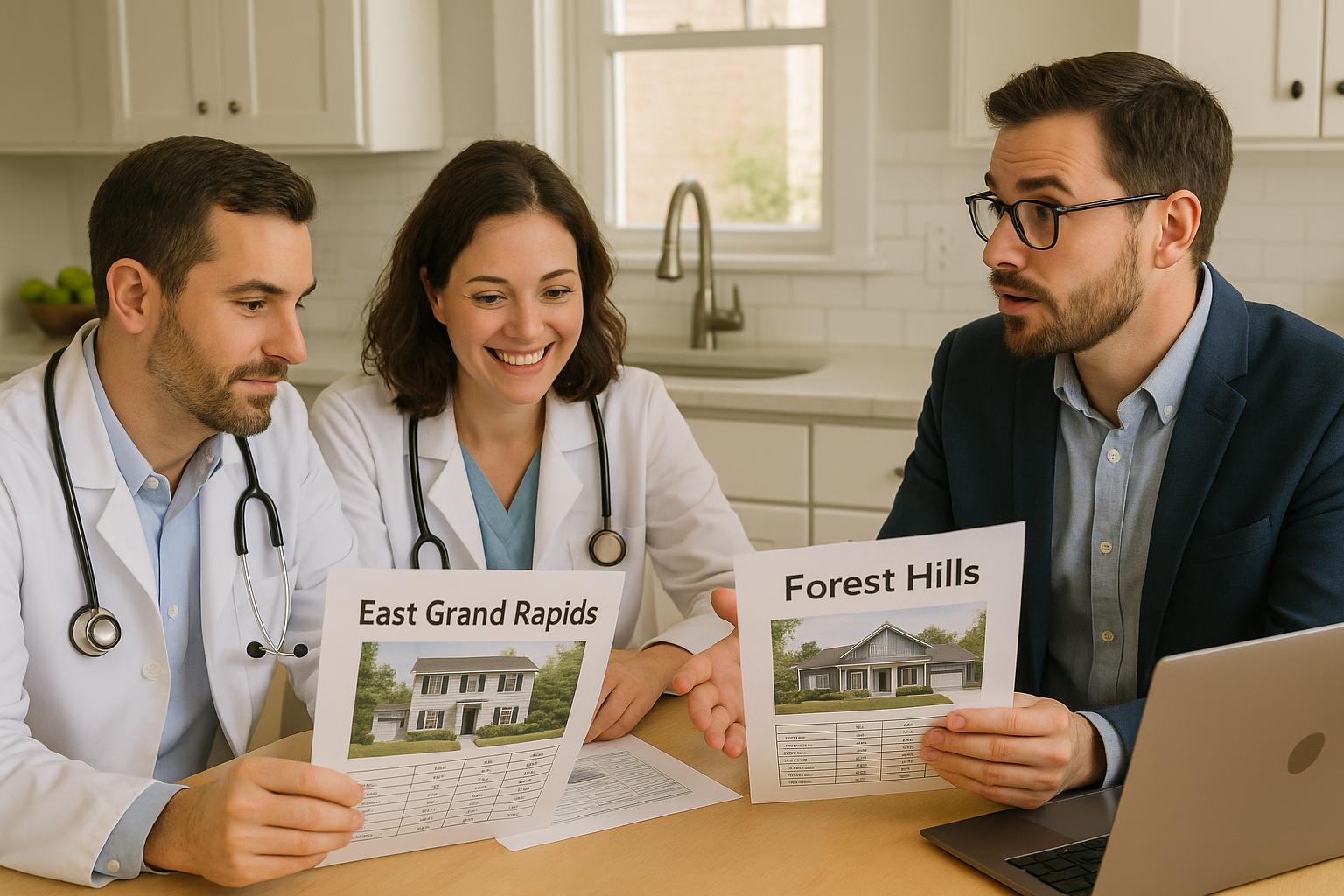
How Physicians Can Choose Between East Grand Rapids and Forest Hills
When deciding between buying a home in East Grand Rapids or Forest Hills, physicians and medical professionals in Grand Rapids are typically focused on commute time, school districts, lifestyle amenities, and how each neighborhood supports work-life balance. Both areas are popular among doctors, residents, fellows, dentists, and veterinarians for different reasons, but the best choice depends on your specific career demands, family needs, and daily routines.
Quick Answer
If you want a short commute to the Medical Mile, East Grand Rapids is often the faster choice, but Forest Hills may offer more space and newer homes for the price. Physicians with young children often prefer Forest Hills for its schools and larger yards, while those seeking a walkable, established neighborhood closer to downtown typically lean toward East Grand Rapids.
Commute and Access to Hospitals
For many physicians, minimizing commute time to the Medical Mile, Corewell Health, or Trinity Health is a top priority. East Grand Rapids is just a few miles from downtown Grand Rapids, making it one of the shortest and most reliable commutes for attending physicians, residents, and fellows. Physicians with frequent call responsibilities or early/late shifts often appreciate being able to get to the hospital in under 15 minutes even during peak traffic.
Forest Hills, while still convenient, is farther east and can add 10–20 minutes to your daily drive depending on your exact location and the time of day. However, if your primary practice or outpatient office is in Ada, Cascade, or the growing medical corridor along East Beltline, Forest Hills could actually be more convenient. If you split time between multiple hospital systems or outpatient locations, mapping out each regular drive is essential. You can review average commute times and typical traffic patterns using local resources or by speaking with colleagues who live in each neighborhood.
Home Style, Lot Size, and Neighborhood Feel
East Grand Rapids features classic homes, mature trees, and a walkable, established neighborhood feel. Many homes were built between the 1920s and 1970s, with unique architecture, sidewalks, and proximity to Reeds Lake, Gaslight Village, and local parks. Lots are generally smaller, and homes may require updates or renovations, which is appealing to some buyers but not all.
Forest Hills, by contrast, offers a mix of newer construction, larger yards, and more modern layouts. If you value a spacious home, finished basement, or a larger lot for kids or pets, Forest Hills often delivers more for your budget. Many subdivisions are designed with families in mind, offering quiet streets and access to excellent schools. However, these neighborhoods may be less walkable, and you’ll likely need a car for most errands.
School Districts and Family Considerations
Both East Grand Rapids and Forest Hills are known for top-performing public schools. East Grand Rapids Public Schools have a long-standing reputation and a small, close-knit district feel. This can be attractive for families wanting an intimate school community and access to local events and sports.
Forest Hills Public Schools cover a much larger geographic area and offer a wider variety of programs, extracurriculars, and modern facilities. Physicians with children often compare specific elementary or middle schools based on location and programming. It’s worth visiting both districts and talking to current parents, especially if your family is transitioning from another state or you’re moving after residency or fellowship. For more information on school ratings and enrollment, visit the Michigan School Data portal.
Budget, Resale Value, and Decision Framework
Physicians often ask which area is the “better investment” or holds value best. In general, East Grand Rapids tends to have higher price-per-square-foot, but homes there are in strong demand due to location and community prestige. Forest Hills usually offers more square footage and newer construction at a lower price point. If you’re buying after residency or fellowship, consider how long you plan to stay: East Grand Rapids homes can be easier to sell quickly due to constant demand, while Forest Hills homes appeal to buyers wanting more space or newer amenities.
A practical decision-making framework is to list your top three daily priorities—such as commute, schools, and home style—and weigh how each area aligns. For example, if your spouse also works downtown or you expect frequent late-night call, East Grand Rapids may tip the scales. If you need a larger home for a growing family, Forest Hills might be the clear choice. Physicians who plan to “move up” in a few years often start in Forest Hills for space, then consider East Grand Rapids when lifestyle needs change. For more local pricing and market trends, see this recent post on Forest Hills home pricing.
Local Grand Rapids Physician Real Estate Insight
Many physicians I work with compare East Grand Rapids and Forest Hills during their transition out of training or when moving up from a condo or smaller first home. Commute to Medical Mile, call schedule flexibility, and school preferences are the main drivers, but timing around a new contract or selling a previous home also plays a big role. It’s common for couples to tour homes in both areas in a single afternoon, weighing the “feel” of each neighborhood alongside practical logistics. In busy recruiting seasons, I’ve seen new attendings choose Forest Hills for space, only to move closer to East Grand Rapids a few years later as their needs shift.
Realistic Physician Buyer or Seller Scenario
One recent physician couple relocating from out of state compared homes in the $600,000–$800,000 range in both East Grand Rapids and Forest Hills. Their contract start date was set for July, so they needed to secure a home by early summer. With two young children and one spouse working at University of Michigan Health-West, they prioritized commute and schools. After touring both areas, they chose Forest Hills for its larger lot and newer construction, but made sure to select a subdivision with easy access to the East Beltline for a manageable drive to the Medical Mile. The lesson: balancing school quality, commute, and daily routines is just as important as price or home style.
Frequently Asked Questions About Physician Real Estate in Grand Rapids
-
Which neighborhood has a shorter commute to the Medical Mile?
East Grand Rapids typically offers the shortest, most predictable commute to the Medical Mile and downtown hospital systems. -
Are homes in Forest Hills generally newer or larger?
Yes, Forest Hills offers more new construction and larger homes for the price compared to East Grand Rapids, which features older, established properties. -
How do school districts compare between the two areas?
Both districts are highly rated, but Forest Hills covers a larger area with more school options, while East Grand Rapids is smaller and more close-knit. -
What should physicians consider if planning to move again in a few years?
If you expect to move up or relocate soon, consider resale demand and how each area aligns with the timing of your next contract or career stage.
Related Physician Real Estate Resources
- Grand Rapids Physician Real Estate Help
- Buying After Residency: Moving From a Condo to Your First Physician Home in Grand Rapids
- Should Medical Residents Rent or Buy in Grand Rapids?
About the Author
Jason Pohlonski
is a Michigan licensed real estate salesperson with Keller Williams Grand Rapids East. He helps buyers and sellers throughout Grand Rapids, East Grand Rapids, Forest Hills, Ada, Byron Center, Jenison, Cascade, and surrounding West Michigan communities.
Jason began his real estate career in Chicago in 2004, later expanding his experience in Ann Arbor from 2014 to 2019, and has been serving clients in the Grand Rapids area since 2019.
With over 20 years of combined real estate experience across multiple markets, Jason focuses on helping clients make clear real estate decisions involving pricing, offer terms, inspections, appraisals, relocation timing, and buy-sell planning.
Jason has worked with physician and medical professional buyers in different stages of the process, including relocation buyers, residents and fellows staying in Grand Rapids after training, move-up buyers purchasing after a new attending role, and clients selling a condo or first home before buying the next property.
Industry Recognition
Jason is recognized by platforms and industry organizations including Zillow, Grand Rapids Magazine Real Estate All-Stars, and Real Producers for his work serving West Michigan buyers and sellers.
Jason also supports One More Moment, a nonprofit that grants wishes to late-stage cancer patients, by donating $100 for every successful closing.
Professional Disclosure
Jason Pohlonski
Michigan Licensed Real Estate Salesperson
License Verification: Verify Michigan License #6501386166
Brokerage: Keller Williams Grand Rapids East
Brokerage Office: 630 Kenmoor Ave SE, Suite 101, Grand Rapids, MI 49546
📱 Call or text: 616-916-9770
📅 Schedule consultation:
https://calendly.com/pohlonskirealestate/30min
📧 Email: jpohlonski@kw.com
This article reflects real client experiences and market conditions in Grand Rapids and surrounding communities at the time of publication. Real estate outcomes can vary depending on market conditions, property characteristics, buyer demand, financing terms, inspection results, appraisal results, and lender requirements.
This article is for general informational purposes only and is not mortgage, legal, tax, or financial advice. Jason Pohlonski is not a lender. Physician loan programs, eligibility, interest rates, down payment options, loan limits, PMI requirements, and mortgage qualification standards vary by lender and borrower. Buyers should speak directly with a qualified mortgage professional before making financing decisions.