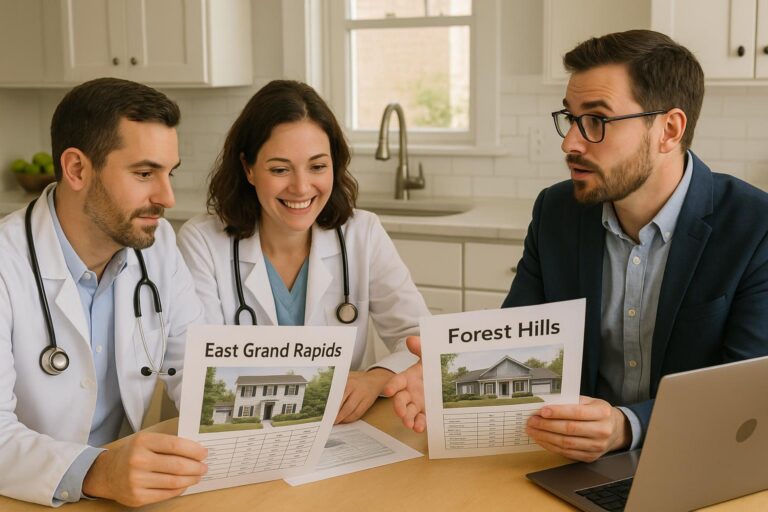
Buying a Home in Grand Rapids With Student Loans as a Physician
Physicians buying a home in Grand Rapids often wonder if their student loans will stand in the way of homeownership. The reality is that while student debt is a factor, it rarely prevents local physicians, residents, or medical professionals from purchasing a home. Instead, your loan payments, contract status, and timing with local lenders are what shape your options, especially with physician-specific mortgages available in West Michigan.
Quick Answer
Physicians in Grand Rapids can typically qualify to buy a home—even with significant student loans—using physician loan programs and careful lender selection. The key is understanding how your debt-to-income ratio, contract timing, and local market factors work together so you can make a confident, realistic offer.
Understand How Student Loans Affect Your Mortgage Approval
Student loans are part of your financial picture, but they don’t automatically disqualify you from buying a home in Grand Rapids. Local lenders evaluate your monthly student loan payments when calculating your debt-to-income (DTI) ratio, which is a major factor in how much home you can afford. Many physician loans offered by regional and national banks specifically accommodate high student loan balances, focusing on your future income and employment contract instead of just your current debt load.
For example, if your loans are in deferment or forbearance, some lenders will use a percentage of the balance as a monthly payment for qualification purposes. Others may use the actual documented payment. Understanding these differences is crucial, so ask each lender how they treat student loans. The Consumer Financial Protection Bureau offers a clear overview of how student loans can impact mortgage applications.
Financing note: Jason Pohlonski is not a lender. Physician loan programs, eligibility, interest rates, down payment options, loan limits, PMI requirements, and mortgage qualification standards vary by lender and borrower. Buyers should speak directly with a qualified mortgage professional before making financing decisions.
Choose the Right Physician Loan and Lender
Grand Rapids physicians have access to specialized physician loan programs that can make home buying more accessible. These loans often allow for little or no down payment, no private mortgage insurance (PMI), and flexible treatment of student loan debt. Not every lender offers the same physician loan terms, so it pays to compare options from local banks, credit unions, and national lenders with a presence in West Michigan.
When choosing a lender, ask about their experience with physician loans and how quickly they can process employment contracts from Corewell Health, Trinity Health, or University of Michigan Health-West. In my experience, some lenders can accept a signed contract and proof of start date up to 90 days before your first paycheck, which is helpful for residents, fellows, or new attendings moving to Grand Rapids. Always get a detailed loan estimate and ask for a breakdown of how your student loan payments are calculated in your approval.
Timing Your Home Purchase Around Residency, Fellowship, or New Contracts
Timing is everything for physicians, especially if you’re buying during a transition between training and a new attending position. Local buyers often plan their purchase to line up with the end of residency, the start of a new contract, or a relocation to Grand Rapids. Lenders may require proof of employment, so having your signed offer letter and start date ready is key. Some physician loans allow you to close up to 60 or even 90 days before your contract begins, but requirements vary.
It’s also practical to consider your call schedule and how it will affect your availability for home showings, inspections, and closing. Many physician buyers in Grand Rapids choose neighborhoods like East Grand Rapids, Forest Hills, Ada, or Cascade for their convenience to the Medical Mile and area hospitals. If you’re relocating from out of state, remote video tours and flexible showing times can help you stay on track. For more on timing your move after training, see Buying After Residency: Moving From a Condo to Your First Physician Home in Grand Rapids.
Applying a Practical Rule of Thumb for Home Affordability
Physicians with student loans should focus on the monthly payment they’re comfortable with, not just the maximum they qualify for. A good rule of thumb is to keep your total monthly housing expenses (mortgage, taxes, insurance, and HOA if applicable) at or below 28–33% of your expected gross income as an attending. This leaves room for loan payments, savings, and unexpected costs.
Before starting your home search, review your student loan documentation and have a recent pay stub or contract ready for your lender. Ask for a pre-approval that includes your actual student loan payment, not just an estimate. If you’re unsure how your debt will affect your buying power, request multiple scenarios from your lender so you can compare home price ranges. For a deeper dive into physician loans, check out Can Doctors Buy a Home in Grand Rapids With a Physician Loan?.
Local Grand Rapids Physician Real Estate Insight
One practical pattern I see among physicians buying in Grand Rapids is a focus on neighborhoods that minimize commute times to the Medical Mile and major hospital campuses. Many buyers compare East Grand Rapids, Forest Hills, and Ada for their school districts and ease of access to Corewell Health or Trinity Health. Timing the purchase to align with the end of residency or a new attending contract is common, and flexibility around closing dates is often needed to balance hospital onboarding, loan approval, and moving schedules.
Realistic Physician Buyer Scenario
A recent physician couple relocating to Grand Rapids for attending roles at Corewell Health faced $220,000 in combined student loans. With signed contracts and a start date two months away, they secured a physician loan with 0% down and no PMI. The lender accepted their offer letters and calculated their DTI using the actual income and documented student loan payments. They focused their search on Forest Hills for the school system and easy Medical Mile access, coordinated virtual showings due to busy call schedules, and closed just before starting their new positions. Their main lesson: early lender conversations and contract paperwork smoothed the process, despite high student debt.
Frequently Asked Questions About Physician Real Estate in Grand Rapids
- Can I buy a home in Grand Rapids with student loans still in forbearance?
Yes, but lenders will use a calculated monthly payment for your student loans, even if they’re not currently due. Ask each lender how they handle loans in forbearance or deferment. - How soon before starting my new attending job can I close on a home?
Many physician loan programs allow you to close 60–90 days before your contract start date, but this varies by lender. Have your signed offer letter and start date ready for pre-approval. - Will my student loan payments limit how much home I can afford?
Student loan payments are part of your debt-to-income calculation, but physician loans often use future income and flexible DTI standards. Ask for multiple pre-approval scenarios to compare options. - Which Grand Rapids neighborhoods do physicians prefer for commutes?
East Grand Rapids, Forest Hills, Ada, and Cascade are popular for their quick access to the Medical Mile, strong schools, and variety of home options.
Related Physician Real Estate Resources
- Grand Rapids Physician Real Estate Help
- Can Doctors Buy a Home in Grand Rapids With a Physician Loan?
- Buying After Residency: Moving From a Condo to Your First Physician Home in Grand Rapids
About the Author
Jason Pohlonski
is a Michigan licensed real estate salesperson with Keller Williams Grand Rapids East. He helps buyers and sellers throughout Grand Rapids, East Grand Rapids, Forest Hills, Ada, Byron Center, Jenison, Cascade, and surrounding West Michigan communities.
Jason began his real estate career in Chicago in 2004, later expanding his experience in Ann Arbor from 2014 to 2019, and has been serving clients in the Grand Rapids area since 2019.
With over 20 years of combined real estate experience across multiple markets, Jason focuses on helping clients make clear real estate decisions involving pricing, offer terms, inspections, appraisals, relocation timing, and buy-sell planning.
Jason has worked with physician and medical professional buyers in different stages of the process, including relocation buyers, residents and fellows staying in Grand Rapids after training, move-up buyers purchasing after a new attending role, and clients selling a condo or first home before buying the next property.
Industry Recognition
Jason is recognized by platforms and industry organizations including Zillow, Grand Rapids Magazine Real Estate All-Stars, and Real Producers for his work serving West Michigan buyers and sellers.
Jason also supports One More Moment, a nonprofit that grants wishes to late-stage cancer patients, by donating $100 for every successful closing.
Professional Disclosure
Jason Pohlonski
Michigan Licensed Real Estate Salesperson
License Verification: Verify Michigan License #6501386166
Brokerage: Keller Williams Grand Rapids East
Brokerage Office: 630 Kenmoor Ave SE, Suite 101, Grand Rapids, MI 49546
📱 Call or text: 616-916-9770
📅 Schedule consultation:
https://calendly.com/pohlonskirealestate/30min
📧 Email: jpohlonski@kw.com
This article reflects real client experiences and market conditions in Grand Rapids and surrounding communities at the time of publication. Real estate outcomes can vary depending on market conditions, property characteristics, buyer demand, financing terms, inspection results, appraisal results, and lender requirements.
This article is for general informational purposes only and is not mortgage, legal, tax, or financial advice. Jason Pohlonski is not a lender. Physician loan programs, eligibility, interest rates, down payment options, loan limits, PMI requirements, and mortgage qualification standards vary by lender and borrower. Buyers should speak directly with a qualified mortgage professional before making financing decisions.